Short answer: Advantage+ Shopping campaigns (ASC) can scale DTC brands in 2026, but they also claim credit for demand that already existed through view-through attribution and returning customers. MER-focused brands run ASC with an existing-customer budget cap, recent-purchaser exclusions, click-based reporting checks, a steady creative pipeline and a weekly blended MER review, so spend only grows when total store revenue grows with it.
ASC's machine learning optimizes toward whoever is most likely to buy. That is exactly what you asked it to do, and it is also the problem. The people most likely to buy are often people already on their way to buy: past customers, email and SMS subscribers, and shoppers who just searched your brand name.
With a 1-day view window, someone who scrolled past an ad and later bought from a Google brand search or a Klaviyo email can count as a Meta sale. The more impressions ASC buys among warm audiences, the more of these "assists" it collects.
Without a cap, ASC can spend a large share of budget on existing customers who would have reordered anyway. In-platform ROAS looks fantastic. New-customer growth stalls.
ASC already retargets site visitors and cart abandoners. If you also run separate retargeting campaigns, you can pay twice to reach the same warm shoppers. Our guide to retargeting and catalog ads in the Advantage+ era covers caps, exclusions and holdout tests for that layer.
The underlying measurement issue is the same one we describe in why ROAS is lying to you and why attribution is failing DTC brands.
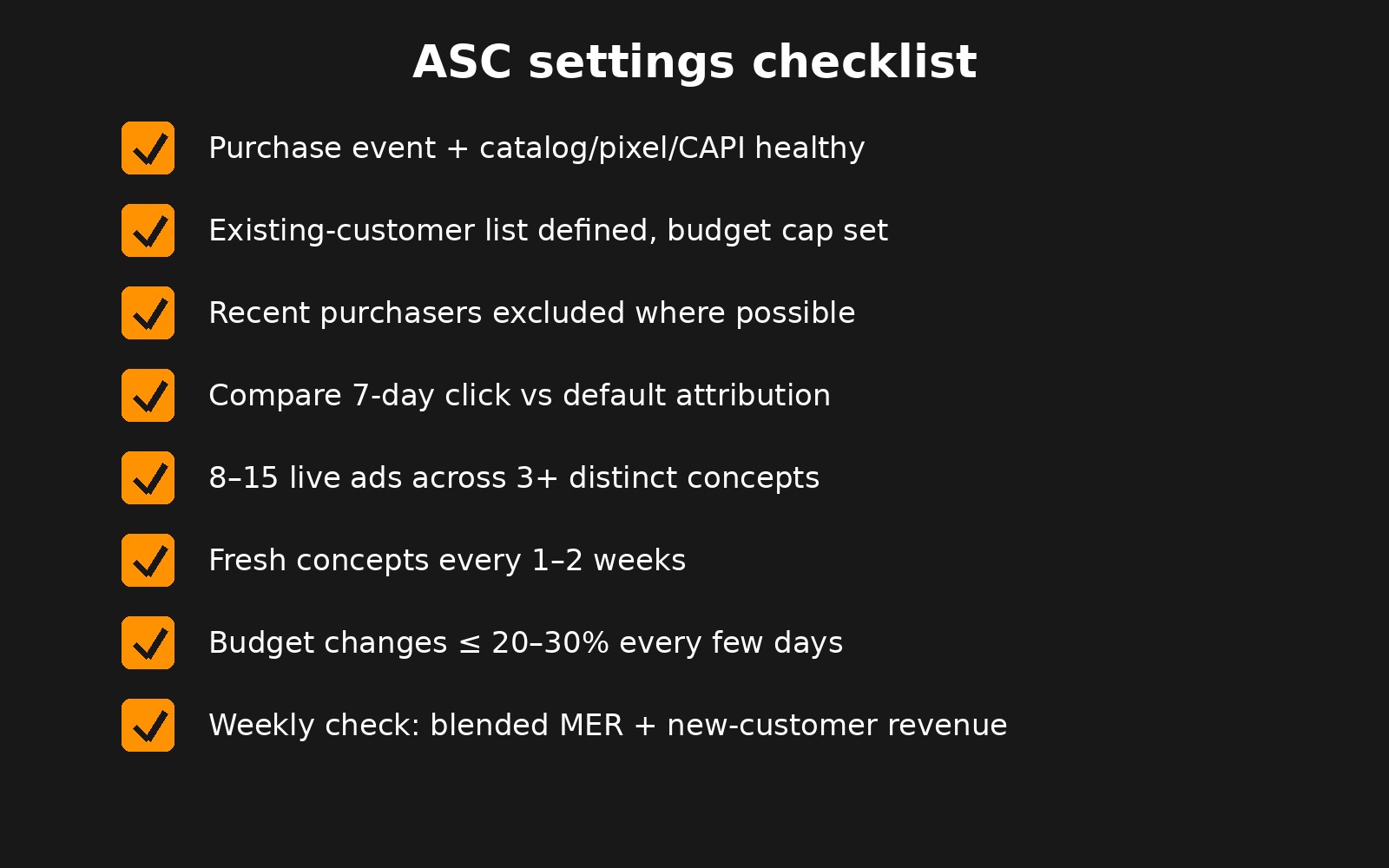
Meta renames and moves settings often, so treat this as a list of things to confirm rather than exact menu paths. Before you trust ASC with real budget, check:
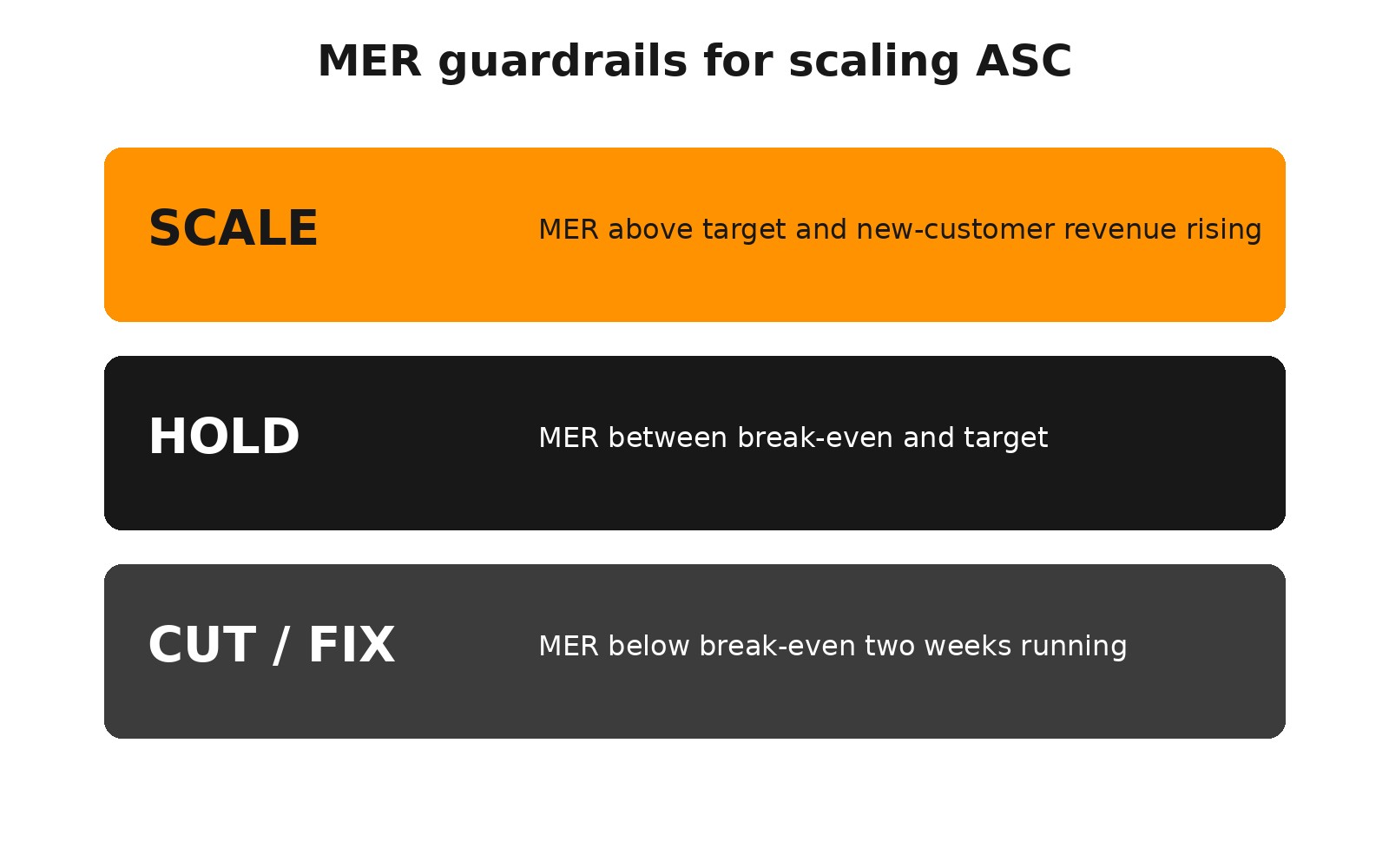
Guardrails turn budget decisions into rules. Start from your break-even MER (1 ÷ contribution margin before ads) and the target MER in your one-page DTC growth plan. Then apply three zones each week:
Add two supporting checks. First, watch whether brand search revenue drops when ASC spend rises; if it does, ASC may be claiming those sales. Second, watch new-customer CAC against your payback window so repeat orders cannot hide weak acquisition. The full method for setting these numbers is in MER vs ROAS: the marketing efficiency ratio explained.
Use store data, not the dashboard. Each week compare ASC spend against total revenue, new-customer revenue and blended MER.
The figures below are illustrative, not client results.
| Week | ASC spend | ASC reported ROAS | Store revenue | Blended MER |
|---|---|---|---|---|
| 1 | $10,000 | 5.0 | $120,000 | 3.4 |
| 2 | $15,000 | 4.8 | $123,000 | 2.9 |
Reported ROAS barely moved, but MER fell because store revenue did not grow with spend. Meta credited ASC with roughly $72,000 in week 2, yet the store only added $3,000. That is the signal to pull back or fix creative.
For a stronger read, run a periodic holdout: pause ASC or hold out a region for two to three weeks and compare revenue trends with a matched control. If revenue barely drops without ASC, much of its reported revenue was demand you already had.
Most underperforming Advantage+ accounts we audit share a handful of fixable problems. None of them show up in the ROAS column, which is why they persist.
Keep the account simple. One ASC campaign for prospecting-heavy scale, plus a small number of manual campaigns for tests, launches or specific products, is enough for most brands. A capped retargeting layer is optional and should earn its place with a holdout.
Creative is now the main targeting lever. Rotate new concepts in every week or two, and remove ads that stop getting spend. See creative testing cadence and budget for DTC brands and the ad idea engine. If ROAS holds but spend refuses to grow, read why your Meta ads aren't scaling even with a solid ROAS.
Our Meta ads agency team runs ASC inside the MER framework of our Engineered Growth System, the same approach behind $50M+ in managed ad spend at a 4.9x average ROAS.
We'll review your ASC setup against your store data and show you the highest-leverage fixes. Book a free growth audit with Lion Media.
Yes for most DTC brands with enough conversion volume, as long as it is judged on blended MER and new-customer revenue rather than in-platform ROAS.
It depends on your goals. Brands focused on acquisition often keep it low; brands with strong repeat purchase may allow more. Set it on purpose rather than leaving it uncapped.
You do not need to change the optimization setting, but you should compare click-only reporting so you understand how much credit comes from views.
A steady flow. Many brands keep 8–15 live ads and add new concepts every one to two weeks so the algorithm has fresh options as older ads fatigue.
Often not. ASC already reaches warm shoppers. If you keep a retargeting layer, cap its budget, exclude recent buyers and prove its lift with a holdout test.
Book a free 30-minute growth audit. We'll review your ads, tracking and site, and show you where the profit is leaking.
No commitment. No pitch deck. A real conversation about your growth architecture.